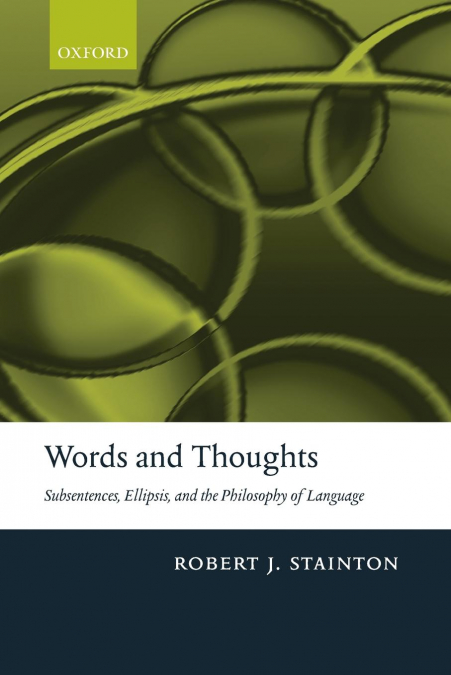
Words and Thoughts Robert J. Stainton
64,13 €
Subsentences, Ellipsis, and the Philosophy of Language
It is a near truism of philosophy of language that sentences are prior to words. Sentences, it is said, are what we believe, assert, and argue for, uses of them constitute our evidence in semantics, only they stand in inferential relations, and are true or false. Sentences are, indeed, the only things that fundamentally have meaning.
Does this near truism really hold of human languages? Robert Stainton, drawing on a wide body of evidence, argues forcefully that speakers can and do use mere words, not sentences, to communicate complete thoughts. He then considers the implications of this empirical result for language-thought relations, various doctrines of sentence primacy, and the semantics-pragmatics boundary.
The book is important both for its philosophical and empirical claims, and for the methodology employed. Stainton illustrates how the methods and detailed results of the various cognitive sciences can bear on central issues in philosophy of language. At the same time, he applies philosophical distinctions with subtlety and care, to show that arguments which seemingly support the primacy of sentences do not really do so. The result is a paradigm example of The New Philosophy of Language: a rich melding of empirical work with traditional philosophy of language.
Ficha Técnica
- ISBN: 9780199250394
- Autor: Robert JStainton, Robert J. Stainton
- Editorial: Oxford University Press
- Páginas: No especificado
- Encuadernación: Tapa Dura
- Dimensiones: 156.00 x 234.00 mm
Si te intereso este libro, te recomendamos:
| isbn | 9780199250394 |
|---|---|
| Categories | Lenguaje y Lingüística |
| Author | Robert J. Stainton |
| Editorial | Oxford University Press |
| Language | INGLES |
| Edition | 1 |
| Fecha public | 2009 |
| Page Number | 262 |
| ancho_mm | 156 |
| Acabado | Tapa Blanda |