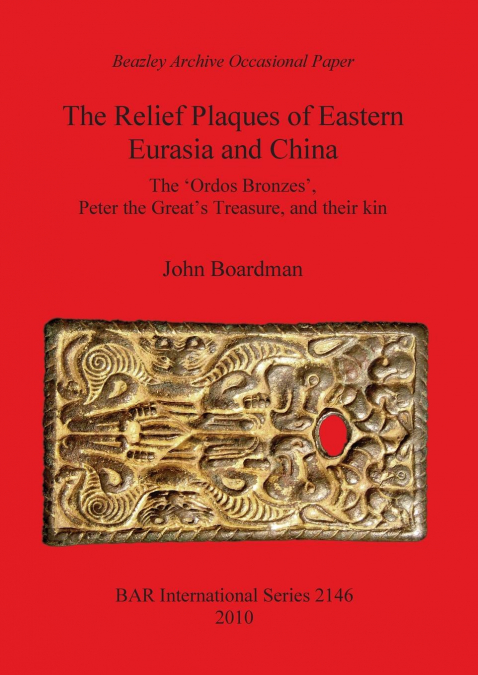
The Relief Plaques of Eastern Eurasia and China John Boardman
101,26 €
The ‘Ordos Bronzes’, Peter the Great’s Treasure, and their kin
',The ',Ordos bronzes', are well known to collectors and many museums, named for the many finds in and around the Ordos plateau in north China. They are …the subject of many catalogues and parts of catalogues of collections [and] have much to tell of contacts and of iconographic inspiration passing, in both directions, from China and from the Steppes… I am dealing with what are generally regarded as belt plaques, not the many animal-only ',Ordos bronzes', of various forms and attachments, which may have been applied to harness or dress or furniture, and which are equally numerous, nor with daggers and the like. The main series considered here (the ',Rope-border', plaques) …begins with works of art of amazing intricacy of composition, combining a certain horror vacui with a desire to indicate all parts of the animal figures involved… The series takes us from over a century before the Qin dynasty ',unification', of China, well into early Han times, roughly from the fourth/third to first centuries BC. Coeval with them, especially in the later period, are other plaque series of different shapes and many of them far less ambitious. These represent more decidedly ',nomad art',, even when their forms and iconography are employed for luxury items of some intricacy, of the type that reached Siberia, and which characterize Peter the Great',s Treasure which had been assembled there, and whether or not some were made by the Chinese for their nomad rivals…Over the whole period studied the interfaces with the arts of Scythians and Sarmatians are apparent, and noted where important, but the subject is only part of the far wider phenomenon of Eurasian arts, a daunting subject. And like all ',art-historical', studies it carries a historical element involving the nature of relations between nomad and settled (to put it at its simplest), as well as the behaviour of owners/wearers. Many ',nomads', of the areas we visit were virtually ',settled',, while among the ',settled', Chinese many lived a transhumance ',nomad', existence. I address this as best I can in the Conclusions, realizing that for many this should be the main reason for such a study. It is likely, however, in the face of the very plentiful material, that a mainly art-historical approach may lead more readily to conclusions of social and historical significance.', (From the author',s Preface)
Ficha Técnica
- ISBN: 9781407306872
- Autor: John Boardman
- Editorial: British Archaeological Reports (Oxford) Ltd
- Páginas: No especificado
- Encuadernación: Tapa Dura
- Dimensiones: 210.00 x 297.00 mm
| isbn | 9781407306872 |
|---|---|
| Categories | Arquitectura, Artes y Musica |
| Author | John Boardman |
| Editorial | British Archaeological Reports Oxford Ltd |
| Language | INGLES |
| Edition | 1 |
| Fecha public | 2010 |
| Page Number | 248 |
| Acabado | Tapa Blanda |